
Silastic
Download
Description
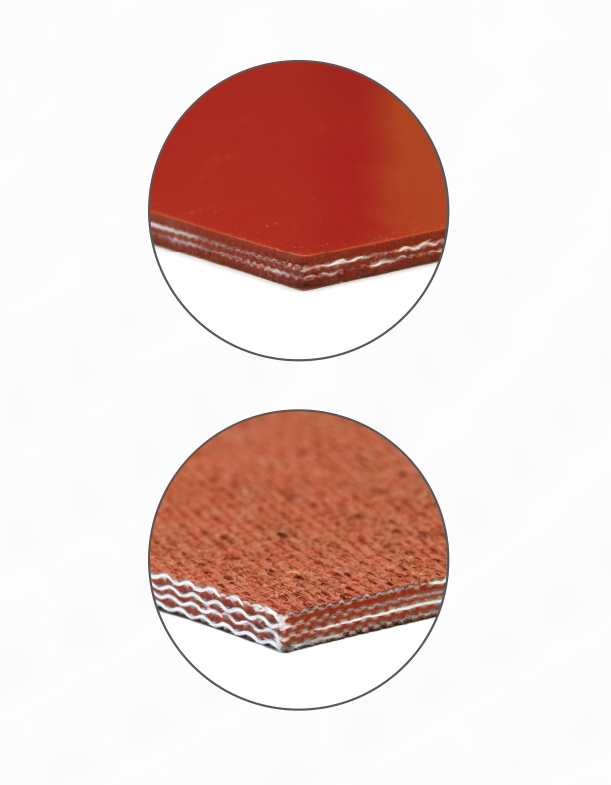
The silastic is made of 2 or more thicknesses of texturized fiberglass cloth laminated together with a red high temperature fireproof silicone. It is offered in a smooth, red oxide or regular finish.
Applications
This material is often used in smelters for tapping operation joints and tolerates high temperatures. The silastic can be use in many applications: gasket for oven door base, supporting part for thermal treatment, general sealing gasket, tadpole, conveyor skirt, high temperature mat, protection curtain, expansion joint and more.
Available with kevlar for a better abrasion resistance and mechanical performance. Max. temperature 600°F.
Specifications
| Thickness | 1/4", 3/8", 1/2", 3/4" |
| Temperature | Silicone: -67°F to 550°F, Fiberglass: 1000°F |
| Color | Red |
| Silicone Dielectric strength (1-mm-sheet) (DIN IEC 243 2) | 23 kV/mm |
| Silicone Dielectric constant at 50 Hz (DIN VDE 0303) | 2.8 εr |
| Silicone Dissipation factor (50 Hz) (DIN VDE 0303) | 20 X 10^-4 tan δ |
| Silicone Volume resistivity (DIN IEC 93) | 5 x 10^15 Ω cm |
| Silicone Hardness Shore A (DIN 53505) | 31 |
| Silicone Density (ISO 1183-1 A) | 1.09g/cm³ |
| Silicone Elongation at break, %(DIN 53504 S 1) | 620 |
| Silicone Tensile strength (N/mm²) (DIN 53504 S 1) | 7.50 |
| Silicone Tear strenght N/mm (ASTM D624B) | 23 |
| Silicone Rebound resilience, % (DIN 53512) | 61 |
| Silicone Compression set (DIN ISO 815-B) | 10 % (22h/175°C) |
| Silicone Flame resistance (UL 94) | HB (0.5 mm) |
| Silicone Gas permeability (DIN 53536) Room temperature | Very high resistance |
| Silicone Gas permeability (DIN 53536) at 68°F | Resistance 30 x superior to natural rubber |
| Silicone Gas permeability (DIN 53536) High temperature | Resistance 400 x superior to butyl rubber (At high temperature, this silicone have similar results than other organic rubber) |
| Silicone High energy radiation resistance | ExcellentNot affected by gamma and beta radiationVery good resistance to microwave |
| Silicone Ozone and UV resistance | Excellent |
| Silicone Strong bases resistance | Good |
| Silicone Oxidizing acids resistance | Bad |
N.B. The information presented may differ from practice. We recommend conducting tests according to the conditions of use. We accept no responsibility for results obtained by the application of this information or the safety and suitability of our products. The data is subject to certain variations without notice.